
Publication Ethics
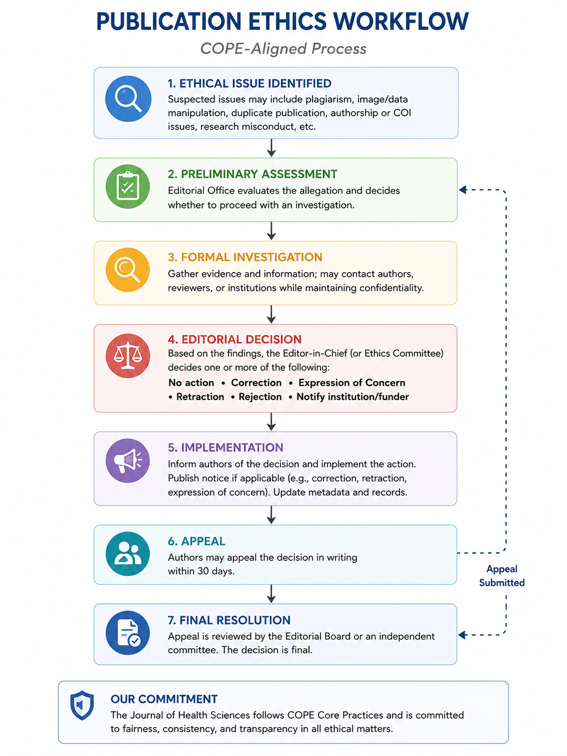
Table of Contents
Submission declaration
When authors submit an article to an JHS it is implied that:
- the work described has not been published previously except in the form of a preprint, an abstract, a published lecture, academic thesis or registered report.
- the article is not under consideration for publication elsewhere.
- the article's publication is approved by all authors and tacitly or explicitly by the responsible authorities where the work was carried out.
- if accepted, the article will not be published elsewhere in the same form, in English or in any other language, including electronically, without the written consent of the copyright-holder.
To verify compliance with our journal publishing policies, we may check your manuscript with our screening tools.
Authorship
All authors should have made substantial contributions to all of the following:
- The conception and design of the study, or acquisition of data, or analysis and interpretation of data
- Drafting the article or revising it critically for important intellectual content.
- Final approval of the version to be submitted.
All authors are accountable for all aspects of the work, to ensure that questions related to the accuracy or integrity of any part of the work are appropriately investigated and resolved.
Authors should appoint a single corresponding author to communicate with the journal during the editorial process. This individual submits the manuscript and all required documentation to the journal, and serves as the primary contact between the journal and the co-authors. Only the corresponding author’s affiliation will be used to determine eligibility for a publishing agreement, and possible discounts related to it. Affiliations of other co-authors are not relevant for eligibility.
Changes to authorship
The editors of this journal generally will not consider changes to authorship once a manuscript has been submitted. It is important that authors carefully consider the authorship list and order of authors and provide a definitive author list at submission.
The policy of this journal around authorship changes:
- All authors must be listed in the manuscript and their details entered into the submission system. Changes can only be made prior to acceptance, and only if approved by the journal editor. This includes additions, deletion, or rearrangement of author names.
- Requests to change authorship: The corresponding author must provide the reason for the request to the journal editor with written confirmation from all authors, including any authors being added or removed, that they agree with the changes. Requests which do not comply with the instructions outlined in the form will not be considered.
- This journal does not allow authorship changes after acceptance. This includes additions, deletions, or the rearrangement of author names, including changes to the corresponding author.
- The review process may be paused while a change in authorship request is being considered.
- Change requests made by the authors editor approval may result in the rejection of the manuscript, or retraction if the article has already been published.
Declaration of competing interests
All authors must disclose any financial and personal relationships with other people or organizations that could inappropriately influence or bias their work. Examples of potential competing interests include:
- Employment
- Consultancies
- Stock ownership
- Honoraria
- Paid expert testimony
- Patent applications or registrations
- Grants or any other funding
- Affiliation with the journal as an Editor or Advisory Board Member
The declarations tool should always be completed.
Authors with a journal affiliation to declare should enter the following text under “Other Activities” within the declarations tool and should inform the journal and publisher prior to completing the submission process:
Given their role as [AUTHOR JOURNAL ROLE TITLE], [AUTHOR NAME] had no involvement in the peer-review of this article and has no access to information regarding its peer-review. Full responsibility for the editorial process for this article was delegated to another journal editor.
Editorial disclosure statements will be included as a footnote and/or in the declaration of competing interest section of the article.
Authors with no competing interests to declare should select the option "I have nothing to declare".
The resulting Word document containing your declaration should be uploaded at the "attach/upload files" step in the submission process. It is important that the Word document is saved in the .doc/.docx file format. Author signatures are not required.
Funding sources
Authors must disclose any funding sources who provided financial support for the conduct of the research and/or preparation of the article. The role of sponsors, if any, should be declared in relation to the study design, collection, analysis and interpretation of data, writing of the report and decision to submit the article for publication. If funding sources had no such involvement this should be stated in your submission.
List funding sources in this standard way to facilitate compliance to funder's requirements:
Funding: This work was supported by the National Institutes of Health [grant numbers xxxx, yyyy]; the Bill & Melinda Gates Foundation, Seattle, WA [grant number zzzz]; and the United States Institutes of Peace [grant number aaaa].
It is not necessary to include detailed descriptions on the program or type of grants, scholarships and awards. When funding is from a block grant or other resources available to a university, college, or other research institution, submit the name of the institute or organization that provided the funding.
If no funding has been provided for the research, it is recommended to include the following sentence:
This research did not receive any specific grant from funding agencies in the public, commercial, or not-for-profit sectors.
Declaration of generative AI use
Authors must declare the use of generative AI tools in the manuscript preparation process upon submission of the paper.
Generative AI and AI-assisted technologies (“AI tools”) have been rapidly adopted in research and scholarly publishing, offering significant benefits while requiring clear standards for responsible and transparent use.
Authors preparing a manuscript for this journal may use AI tools to support them. However, these tools must never be used as a substitute for human critical thinking, expertise and evaluation. AI tools may only be applied with human oversight and control.
Ultimately, authors are responsible and accountable for the contents of their work. This includes accountability for:
- Carefully reviewing and verifying the accuracy, comprehensiveness, and impartiality of all AI-generated output (including checking the sources, as AI-generated references can be incorrect or fabricated).
- Editing and adapting all material thoroughly to ensure the manuscript represents the author’s authentic and original contribution and reflects their own analysis, interpretation, insights and ideas.
- Ensuring accuracy and originality of any AI generated images and provide appropriate attribution where relevant.
- Ensuring the use of any tools or sources, AI-based or otherwise, is made clear and transparent to readers. If AI tools have been used, we require a disclosure statement upon submission; please see example below.
- Ensuring the manuscript is developed in a way that safeguards data privacy, intellectual property and other rights, by checking the terms and conditions of any AI tool that is used.
Finally, authors must not list or cite AI tools as an author or co-author on the manuscript since authorship implies responsibilities and tasks that can only be attributed to, and performed by, humans.
The use of AI tools in the manuscript preparation process must be declared by adding a statement at the end of the manuscript when the paper is first submitted. The statement will appear in the published work and should be placed in a new section before the references list. An example:
Title of new section: Declaration of generative AI and AI-assisted technologies in the manuscript preparation process.
Statement: During the preparation of this work the author(s) used [NAME OF TOOL / SERVICE] in order to [REASON]. After using this tool/service, the author(s) reviewed and edited the content as needed and take(s) full responsibility for the content of the published article.
The declaration does not apply to the use of basic tools, such as tools used to check grammar, spelling and references. In addition, authors are not required to disclose the use of AI tools or features within specialist disability-related assistive technology, provided these are used solely for accessibility purposes.
If you have nothing to disclose, you do not need to add a statement.
Please note: to protect authors’ rights and the confidentiality of their research, this journal does not currently allow academic editors and reviewers to upload an unpublished manuscript into a generative AI tool. However, AI tools may be used in a supportive capacity by editors and reviewers to improve structure and language of the review report or editorial decision letter or to conduct a background literature search.
Image manipulation
We accept that authors sometimes need to adjust images for clarity but any manipulation of images for the purpose of deception or fraud will be seen as scientific ethical abuse and will be dealt with accordingly.
Authors must adhere to this journal’s policy for graphical images:
- No specific feature within an image may be enhanced, obscured, moved, removed or introduced.
- Adjustments of brightness, contrast, or color balance are acceptable if, and only as long as, they do not obscure or eliminate any information present in the original image.
- Nonlinear adjustments such as changes to gamma settings must be disclosed in the figure legend.
- Use of AI tools to create or manipulate primary research images is not permitted. This includes images that represent experimental or observational data, such as western blots, microscopy images, histology images, or patient images. Please read our policy on the use of AI tools in figures, images and artwork.
- To verify compliance with the above, this journal may send your images to a secure third-party tool to enable screening for image irregularities. Our editors may ask you to provide original data or images if any questions arise as a result of the screening. The final decision as to whether images are acceptable will be taken by our editors.
Authors are encouraged to carefully check all images before submission and to connect all the data in any figures to the original, unprocessed data.
Jurisdictional claims
JHS respects the decisions taken by its authors as to how they choose to designate territories and identify their affiliations in their published content. JHS’s policy is to take a neutral position with respect to territorial disputes or jurisdictional claims, including, but not limited to, maps and institutional affiliations.
- Maps: Readers should be able to locate any study areas shown within maps using common mapping platforms. Maps should only show the area actually studied and authors should not include a location map which displays a larger area than the bounding box of the study area. Authors should add a note clearly stating that "map lines delineate study areas and do not necessarily depict accepted national boundaries”. During the review process, JHS’s editors may request authors to change maps if these guidelines are not followed.
- Institutional affiliations: Authors should use either the full, standard title of their institution or the standard abbreviation of the institutional name so that the institutional name can be independently verified for research integrity purposes.
Delayed publication
If you need to delay the publication of your article for any reason, please contact the editorial office of the journal at the earliest possible opportunity. While we will try to ensure that your article is not published before a certain date if you make your request on a timely basis, we cannot guarantee this. Please also note that once the agreed period of delay has expired the article may be published at any time thereafter.
Withdrawal, correction or retraction
For questions about article withdrawal, correction, or retraction, please consult Editor’s team.