


Work engagement of healthcare workers and related factors in selected Class I hospitals in Ho Chi Minh City
- University of Health Sciences, Viet Nam National University Ho Chi Minh City
Abstract
Objective: To assess the level of work engagement among healthcare workers at participating public Class I hospitals in Ho Chi Minh City and examine its associations with related factors.
Methods: A cross-sectional survey was conducted from April to June 2024 among 385 healthcare workers at three selected public Class I hospitals in Ho Chi Minh City using convenience sampling. Work engagement was measured using the Vietnamese version of the 9-item Utrecht Work Engagement Scale (UWES-9-V), encompassing three dimensions: vigor, dedication, and absorption. Background variables and organizational factors—perceptions of corporate social responsibility (CSR), organizational trust, hospital reputation, and IT application—were also assessed. Data were analyzed using non-parametric tests and multivariable regression models.
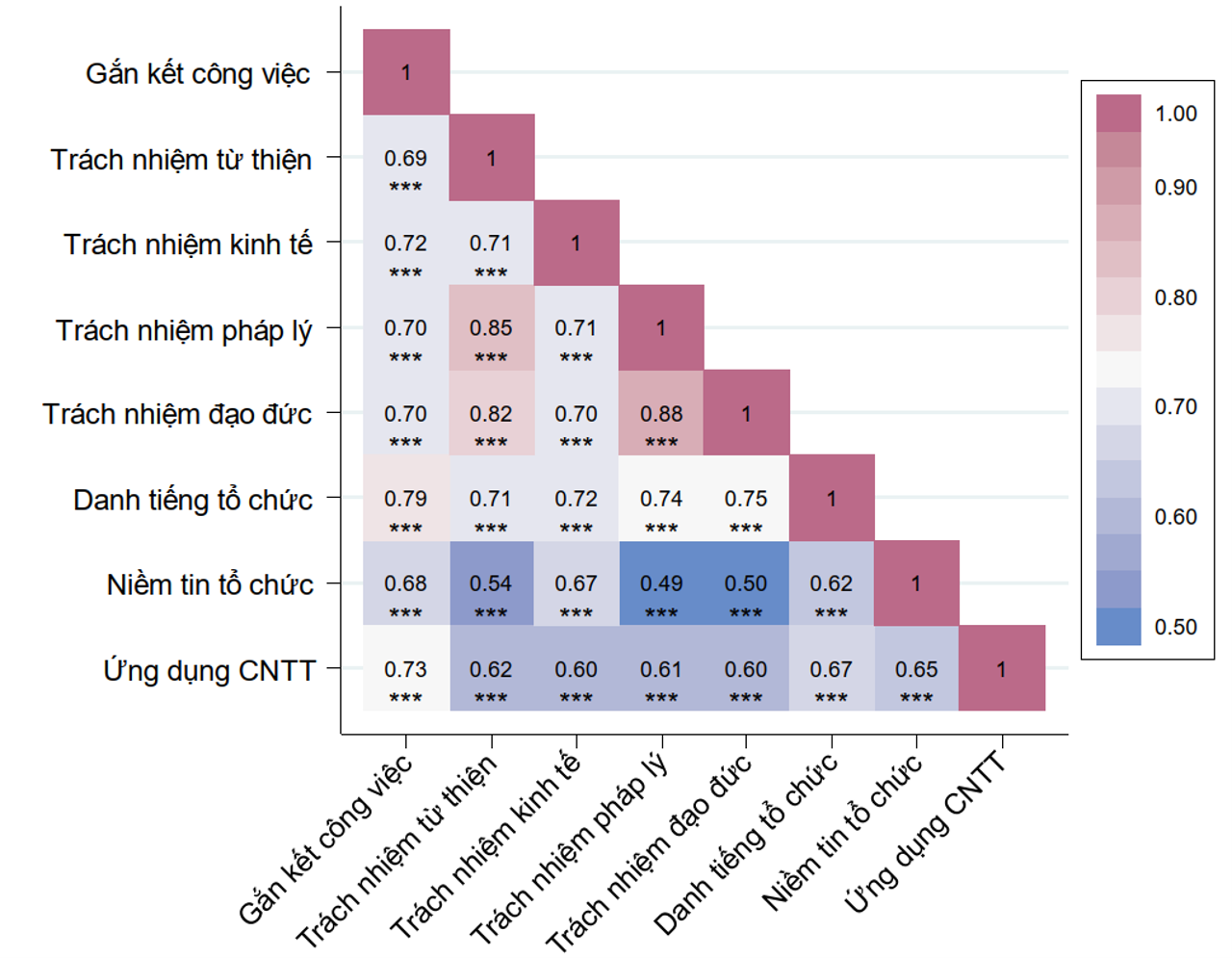
Results: The overall mean engagement score was 3.8 ± 0.7 (Likert 5-point scale), with dedication scoring the highest (3.9 ± 0.76). Educational attainment was associated with overall engagement, and professional specialty was associated with vigor. Spearman correlation showed strong positive associations between engagement and organizational factors, notably organizational reputation (ρ = 0.79), information technology application (ρ = 0.73), and economic responsibility (ρ = 0.72). Multivariable regression analysis indicated that organizational trust (β = 0.30), IT application (β = 0.21), and economic responsibility (β = 0.13) were independently associated with work engagement (R² = 73.8%, p < 0.001).
Conclusion: Healthcare workers at the three participating public Class I hospitals in Ho Chi Minh City demonstrated a relatively high level of work engagement. These findings suggest that organizational trust, transparency, technological infrastructure, and financial fairness should be considered in strategies to improve work engagement. These findings support the development of targeted interventions to retain healthcare talent in the public sector.