


Formulation of virgin coconut oil microemulsion with natural excipients
- Faculty of Pharmacy, University of Medicine and Pharmacy at Ho Chi Minh City, Viet Nam
Abstract
Introduction: Virgin coconut (Cocos nucifera (L.)) oil (VCO) is taking attention from re-searchers because of its biological activities. However, applying VCO directly on the skin often leaves an uncomfortable feeling of greasy, clogged pores and difficult to wash. Coco-nut oil in microemulsion is a better option since it can increase bioavailability as well as convenience for users. Furthermore, this study aims to use natural ingredients, safe for the skin and environmentally friendly.
Methods: The research started from extracting saponins from Gleditsia australis by using ethanol and water as extraction solvents. The extracted saponins were characterized by chemical reactions. Then we combined saponins and some other surfactants to investigate the possibility of microemulsion formation.
Results: We extracted saponins with efficiency of 7.2%. The results showed that microemul-sions were formed using a mixture of surfactants including saponins and lecithin (ratio of 0.05:100 w:w) in the formula with a ratio of water phase, oil phase, surfactants respectively 3%, 48.5%, 48.5%. Microemulsion met the requirements of quality control and the product is microbiologically stable after 3 months of storage without using preservatives.
Conclusion: In this study, we have successfully prepared Virgin coconut oil microemulsion using natural excipients including Virgin coconut oil, water and a mixture of surfactants used as saponins and lecithin. The system showed stability at 30 and 40 °C upon three-month storage and the product is microbiologically stable after 3 months of storage without using preservatives.
INTRODUCTION
Skin is our first and best defense against external aggressors. It is the most visible indicator of health. However, when the skin is dry, depending on the degree of dryness these functions no longer work as well as before. Skin becomes more sensitive to the sun, more vulnerable to damage and to inflammation, and promotes cellular senescence 1. Especially in cases of chronic diseases such as psoriasis and atopic dermatitis, combination of medicinal treatment and moisturizers significantly improves the therapeutic effects. Natural products containing bioactive ingredients with various benefits, such as antioxidant, anti-inflammatory and antibacterial, are more and more popular 2, 3.
VCO has been studied for its beneficial biological effects4, 5. It has long been used to moisturize and treat skin infections6. Due to its safety and efficacy, VCO is used as a therapeutic moisturizer and has been shown to be effective on mild to moderate xerosis 7. There have been several studies of virgin coconut oil microemulsions (COM) using a mixture of synthetic surfactants, the two most common were Span and Tween.
However, using a large amount of chemicals for production has a negative impact on the environment as well as human health. Therefore, the study aims to examine natural surfactants because of their high biological compatibility with the skin as well as their environmental friendliness. In which, saponins present in Gleditsia australis is an abundant source of raw materials in nature. Because saponins have not been commercialized, the research went from extracting saponins and then using them to study the formulation of COM.
MATERIALS AND METHODES
Materials
VCO is a product of Luong Quoi Coconut Co., LTD. Gleditsia australis fruits harvested in CuChi, HoChiMinh city, Vietnam. Ethanol, acetone, n-hexane, n-butanol, ethyl acetate to extract saponins were purchased from China (Xilong, research laboratory standard). Lecithin (powder, L-a-phosphatidylcholine, HLB 4-7 according to supplier) was purchased from Lipoid (Germany). Non-ionic surfactants, polyoxyethylene sorbitan monooleate (Tween 80), sorbitan monooleate (Span 80) were purchased from China (Xilong, research laboratory standard). Distilled deionized water was used in all experiments.
Methods
Extraction of saponins from Gleditsia australis fruits
First, the medicinal herbs was broken down and the extraction was done by soaking the dried plant material in 70% ethanol with herbal:solvent ratio is 1:5 in 2 hours at room temperature and then at 80 C by using the temperatured water bath. The extraction was then shaking with three time with ethyl acetate (extraction : ethyl acetate 1 : 1 v : v) to remove non-polar impurities. Discard the ethyl acetate solution and the extractioin was then shaking with n-butanol. The n-butanol fraction was collected and evaporated to obtain a total saponins precipitate.
Determination of the required HLB values for VCO and the HLB of saponins
The required HLB and HLB values were determined by monitoring the phase separation time of the emulsion using the mixture of surfactants with different HLB values. The emulsion formulation used for the tests consisted of 75% VCO, 5% water and 20% surfactants. Briefly, VCO, water and surfactant was weighted into the glass tube with the quantity of 0.75 g, 0.5 g and 2 g respectively. The tube was closed with plastic cap. This mixture were vortexed in five minutes. The most stable formultations was seledcted for rHLB and HLB calcuation. With the formulation using tween 80 as surfactant, we can calculated the rHLB of VCO. Based on this result, we calculated the HLB of saponins. The rHLB / HLB value was calulated as described in Tuba (2020)8.
Preparation of microemulsions
The ternary phase diagram that consisted of oil, water, and surfactant/co-surfactant (S/Co-S) mixtures were constructed using water titration method as described in Amol et al. (2021) 9. The phase diagrams were prepared with fixed weight ratio of surfactants/co-surfactants (S/Co-S). This ratio was obtained based on the principle that the HLB value of the surfactant mixture was equal to the rHLB value of VCO. In cases where this ratio fails to produce microemulsion, different S/Co-S ratios are investigated. For each phase diagram, the weight of oil to surfactant or surfactant/co-surfactant (S/Co-S) ratio were varied as 1:9, 2:8, 3:7, 4:6, 5:5, 6:4, 7:3, 8:2 and 9:1 (w/w) 10, 11.
Based on this principle, the study of the formula is carried out in three steps, including screening of surfactants, investigation of the ratio between oil phase and mixture of surfactants and screening of the water phase ratio in the microemulsion formula.
Evaluate some properties of finished microemulsion
Evaluation of some properties of finished microemulsion including pH, relative density, centrifugal and thermal stability, electrical conductivity and qualitative by thin layer chromatography as described below.
pH: Glass electrode pH measurements (Mettler Toledo S220K) have been carried out for our microemulsions formulation. The measurement was repeated three times.
Density of microemulsion was determined by using the pycnometer.
The thermal stability of microemulsion was characterized by thermal cycle. The microemulsion was kept at 50 °C (in water bath) for 12 hours and then at 4 °C (in refrigerator) for 12 hours and finally at room temperature for 12 hours. The cycles were repeated at least 5 times.
The conductivity of the microemulsion was measured directedly by conductivity meter (Mettler Toledo, Electrode LE438)
Thin layer chromatography was carried out on GF 254 pre-coated plate. 1 g of sample test or standard sample (coconut oil) was dissolved in 10 mL of diethyl ether and shaked well. The mobile phase was n-hexane: ethyl acetate: glacial acetic acid (8: 2: 0.5). The peaks were discovered by vanillin-sulfuric reagent.
Preliminarey inspection of product stability
Inspection of the product stability under the influence of natural light and temperature (10, 30, 40 C) after 3 months based on the specifications of description, pH and electrical conductivity.
Preliminary study about skin irritancy test
Skin irritation test is conducted with three rabbits. Test substance (0.5 g solid or 0.5 mL liquid) is applied on the small area (10 cm x 15 cm), and then the treated site is covered with a patch. Patch is removed and then, signs of erythema and edema, and the responses are scored at 1, 24, 48 and 72 hours. Erythema and edema are scored with grades from 0 to 4 depending on the severity 12, 13.
Inspection of product efficiency
Inspection of product efficiency on 25 volunteers based on questionnaire survey. The questionnaire survey is presented in Table 1.
Questionnaire survey
|
Questionnaire (0-10 rating scale*) | |
|
1 |
The fondness for the smell of the product |
|
2 |
Feeling of greasy after using the product |
|
3 |
Excess amount of product remains on the skin after using the product |
|
4 |
Soft feeling of skin after using the product |
|
5 |
Skin irritancy |
Assess self-preservation ability of microemulsion
Assess self-preservation ability of the product after 3 months of storage based on Vietnamese specified standards in Circular No. 06/2011/TT-BYT.
RESULTS AND DISCUSSION
Extract saponins from Gleditsia australis fruits
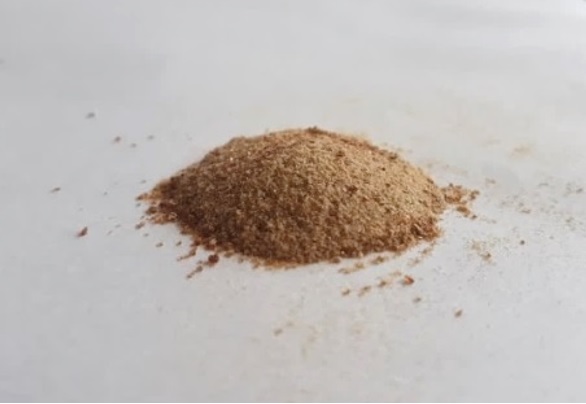
Saponins extracted from
The extracted saponin is shown in Figure 1.
Extraction efficiency: 7.2%
Description: brown powder, causing sneezing.
Qualitative: The solids obtained are positive for the Liebermann - Burchard reaction (purple ring), creating stable foam in water.
Determine the required HLB values for VCO and the HLB of the saponins
Survey results rHLB value of VCO
|
HLB |
4.3 |
5 |
6 |
7 |
8 |
9 |
10 |
11 |
12 |
13 |
14 |
15 |
|
Phase separation time (minutes) |
6 |
8 |
9 |
9 |
11 |
10 |
9 |
9 |
7 |
6 |
6 |
3 |

The chart shows the phase separation time of the coconut oil emulsion with hypothetical HLB values of saponins
The result of experimental rHLB of VCO is shown in Table 2 and Figure 2.
Conclusion: Choose rHLB of VCO is 8, HLB of saponins is 24.
Formulation of COM
Screening of surfactants
Mixture of surfactants including saponins and Span 80
The ability to create microemulsion with different mixture of surfactants including saponins and span 80 is shown in Table 3.
Investigation of the formation of COM with a mixture of surfactants including saponins and Span 80
|
Saponins : Span 80 |
|
2:100 |
1:100 |
|
Ability to create microemulsions |
- |
+ |
+ |

Phase diagram using a mixture of surfactants including saponins and Span 80 (Ratio between saponins and Span 80, figure a is 2:100, figure b is 1:100)
The pseu-do diagram of microemulsion with mixutre of surfactants including saponins and span 80 is shown in Figure 3.
Mixture of surfactants including saponins, Span 80 and Tween 80 (HLB=8)

Phase diagram using a mixture of surfactants has an HLB value of 8
The pseu-do diagram of microemulsion with mixutre of surfactants including saponins, span 80, tween 80 is shown in Figure 4.
Mixture of surfactants including saponins and lecithin
The ability to create microemulsion with different mixture of surfactants including saponins and lecithin is shown in Table 4.
Investigation of the formation of COM with the mixture of surfactants including saponins and lecithin
|
Saponins : Lecithin |
> 0.05:100 |
0.05:100 |
|
Ability to create microemulsion |
- |
+ |
The pseu-do diagram of microemulsion with mixutre of surfactants including saponins, lecithin is shown in Figure 5.

Phase diagram using the mixture of surfactants including saponins and lecithin
The comparison between formulations using mixtures of different surfactants is shown in Table 5.
Comparison between formulations using mixtures of different surfactants
|
Mixture of surfactants |
Physical appearance |
Microemulsion forming zones |
Natural excipients |
|
Saponins, Span 80 |
Translucent |
+ |
- |
|
Saponins, Span 80, Tween 80 |
Transparent |
+++ |
- |
|
Saponins, Lecithin |
Transparent |
++ |
+ |
Select the mixture of surfactants including saponins and lecithin for further investigation as it meets the requirements of all-natural ingredients and a relatively wide microemulsion forming zones.
Investigation of the ratio between oil phase and mixture of surfactants
Investigation of the ratio between oil phase and mixture of surfactants
|
VCO : S-CoS |
9:1 |
8:2 |
7:3 |
6:4 |
5:5 |
4:6 |
3:7 |
2:8 |
1:9 |
|
Stability after thermal cycles |
- |
- |
- |
- |
+ |
+ |
+ |
+ |
+ |
The investigation of the ratio between oil phase and mixture of surfactants is shown in Table 6. Selected the ratio of VCO and active substance mixture is 5:5 for further investigation because it contains the highest percentage of VCO and still meets the requirements of stability after the thermal cycle test.
Investigation of the water phase ratio in the microemulsion formula
The investigation of the water phase ratio in thermal stability is shown in Table 7.
Investigation of the water phase ratio
|
Ingredients (%) |
Formula 1 |
Formula 2 |
Formula 3 |
|
VCO (%) |
49 |
48.5 |
48 |
|
Water (%) |
2 |
3 |
4 |
|
Saponins (%) |
0.0233 |
0.0231 |
0.0229 |
|
Lecithin (%) |
48.98 |
48.48 |
47.98 |
|
Stability after thermal cycles |
+ |
+ |
- |
The selected ratio of water in the formula is 3% because it contains the highest percentage of water and still meets the requirements of stability after the thermal cycle test. This formulation is shown in Figure 6.

Virgin coconut oil microemulsion
Evaluation of some properties of finished microemulsion
The evaluation of some properties of finished microemulsion is presented in Table 8.
Evaluation of some properties of finished microemulsion
|
Properties |
Results | |
|
Description |
Microemulsion is transparent, yellow-brown color, thermodynamically stable, isotropic liquid | |
|
pH |
6.047 | |
|
Relative density |
0.9733 g/ml | |
|
Stability |
Thermal cycles |
Microemulsion remains stable after 3 thermal cycles |
|
Centrifugation |
Microemulsion remains stable after centrifuging at 3500 rpm | |
|
Electrical conductivity |
0.6 μS/cm | |
|
Qualitative by thin layer chromatography |
The principal spot in the chromatogram obtained with the test solution corresponds to the spot in the chromatogram obtained with the reference solution in the colour, the size and the retardation factor (Rf = 0.37) | |
Inspection of product stability
The result of product stability is shown in Table 9.
Inspection of the influence of natural light and temperature
|
Properties |
Results | ||
|
Description |
pH |
Electrical conductivity | |
|
Influence of natural light |
Transparent, homogeneous, yellow-brown color |
6.09 ± 0.07 |
0.6 (μS/cm) |
|
Influence of temperature (10, 30, 40 oC) |
Transparent, homogeneous, yellow-brown color |
6.13 ± 0.11 |
0.6 (μS/cm) |
Skin irritancy test
The result of skin irritancy test is shown in Table 10.
Results of skin irritancy test
|
Rabbit No. |
Time | |||||||||||||||
|
1 hour |
24 hours |
48 hours |
72 hours | |||||||||||||
|
T |
R |
T |
R |
T |
R |
T |
R | |||||||||
|
ER |
E |
ER |
E |
ER |
E |
ER |
E |
ER |
E |
ER |
E |
ER |
E |
ER |
E | |
|
1 |
0 |
0 |
0 |
0 |
0 |
0 |
0 |
0 |
0 |
0 |
0 |
0 |
0 |
0 |
0 |
0 |
|
2 |
0 |
0 |
0 |
0 |
0 |
0 |
0 |
0 |
0 |
0 |
0 |
0 |
0 |
0 |
0 |
0 |
|
3 |
0 |
0 |
0 |
0 |
0 |
0 |
0 |
0 |
0 |
0 |
0 |
0 |
0 |
0 |
1 |
0 |
|
Average |
0 |
0 |
0 |
0 |
0 |
0 |
0 |
0 |
0 |
0 |
0 |
0 |
0 |
0 |
0.33 |
0 |
Examination of product efficiency
The result of the survey is shown in Figure 7. The microemulsion is far more acceptable than the VCO.
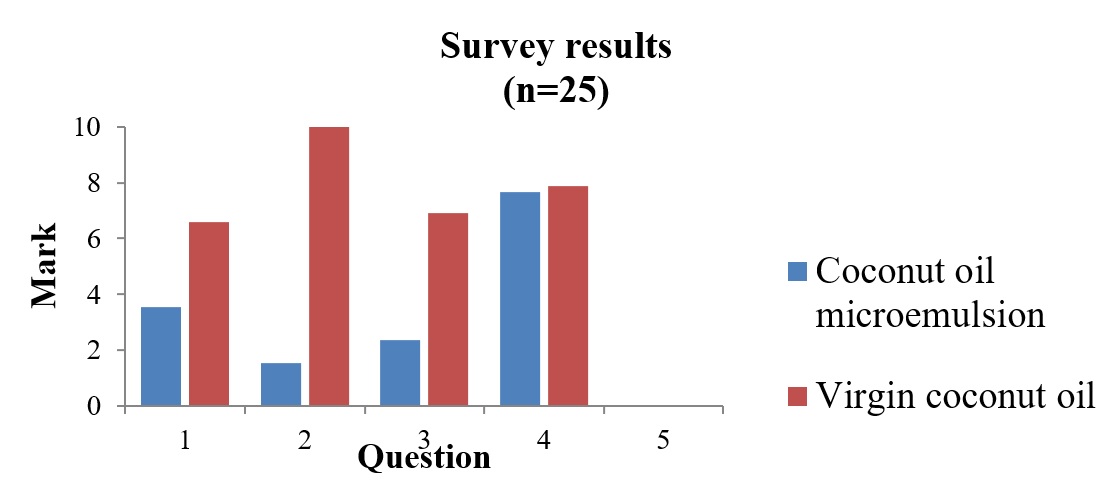
The chart shows the survey results on volunteers
Preliminary assessment of self-preservation ability of microemulsion
The preliminary assessment of self-microbiological preservation ability of microemulsion is shown in Table 11.
Results of the assessment of self-preservation ability of microemulsion
|
Specified standards in Circular No. 06/2011/TT-BYT |
Results | ||
|
Types of microorganisms |
Products for children under 3 years old |
Other products | |
|
Total Aerobic Mesophilic Microorganisms (Bacteria, Yeast and Molds) |
≤ 500 CFU/g or CFU/ml |
≤ 1000 CFU/g or CFU/ml |
< 10 CFU/g |
|
P. aeruginosa |
Absent in 0.1 g or 0.1 ml test sample |
Absent in 0.1 g or 0.1 ml test sample |
Not found |
|
S. aureus |
Absent in 0.1 g or 0.1 ml test sample |
Absent in 0.1 g or 0.1 ml test sample |
Not found |
|
C. albicans |
Absent in per 0.1 g or 0.1 ml test sample |
Absent in 0.1 g or 0.1 ml test sample |
Not found |
Conclusion: COM meets the requirements of the product for children under 3 years old.
CONCLUSION
In this study, we have successfully prepared Virgin coconut oil microemulsion using natural excipients including virgin coconut oil, water and a mixture of surfactants used as saponins and lecithin. The system showed stability at 30 and 40°C upon three-month storage and the product is microbiologically stable after 3 months of storage without using preservatives.
The microemulsion with coconut oil has been published elsewhere, however, this is the first time the coconut microemulsion was made with natural excipients. Although there is still many questions such as microemulsion type, the scale up steps... this result is the first step to reach to the national market and to make value for our country's product.
CONFLICTS OF INTEREST
The authors declare no conflict of interest.
AUTHORS’ CONTRIBUTION
Conceptualization, Van-Thanh Tran;
Exepriments: Thi-Tuyet-Nhi Pham
Methodology: Ngoc-Quynh Le, Ngoc-Son Nguyen, Xuan-Truong Le, Van-Thanh Tran
Writing-original draft, Thi-Tuyet-Nhi Pham, Ngoc-Quynh Le, Khoi-Nguyen Vo, Ngoc-Son Nguyen, Xuan-Truong Le, Van-Thanh Tran.
Writing-review and editing, Ngoc-Quynh Le, Khoi-Nguyen Vo, Ngoc-Son Nguyen, Xuan-Truong Le, Van-Thanh Tran.
All authors have read and agreed to the published version of the manuscript.
FUNDING
This research received no external funding.